
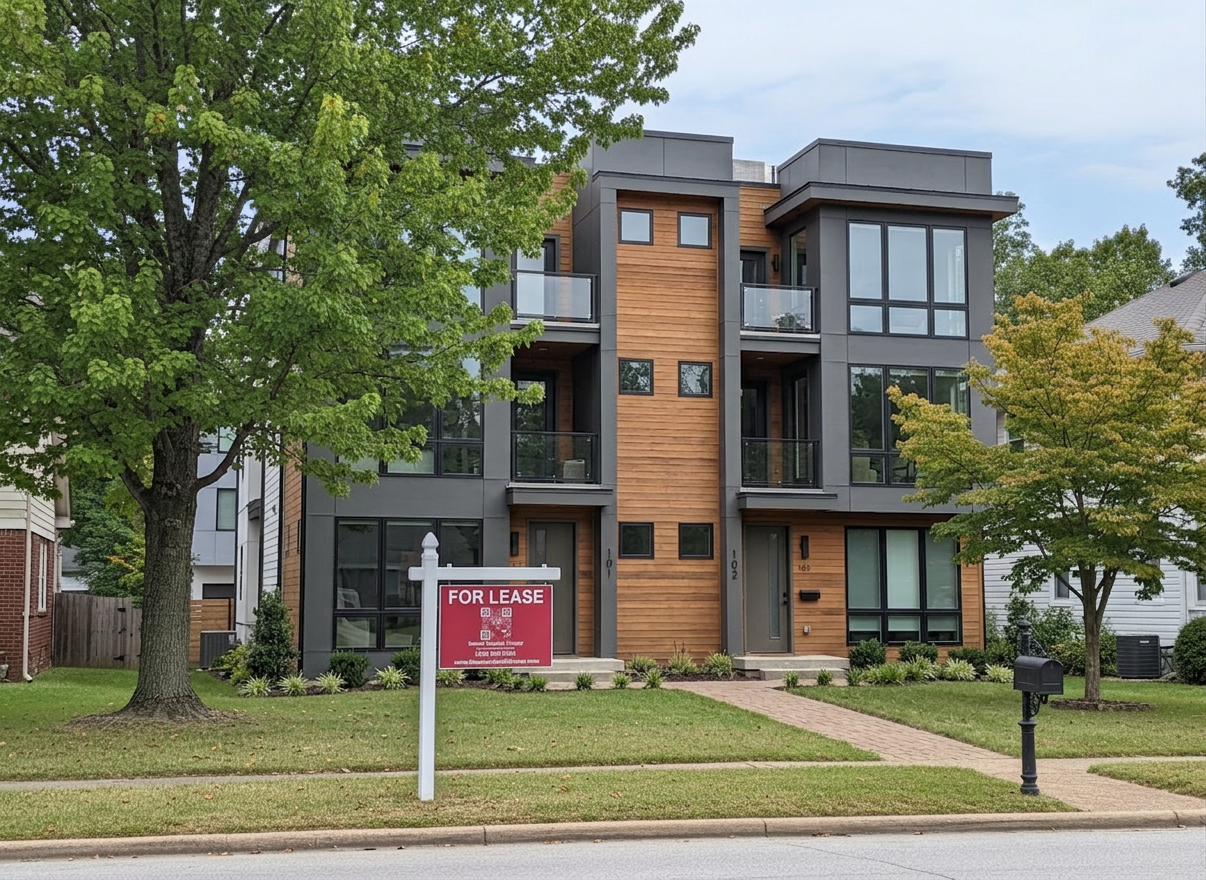
National housing inventory climbed 4.3% year over year to exceed 1.4 million active listings in May 2026, with broad-based gains across all property types and the majority of U.S. markets. Yet this headline growth masks a complex, bifurcated reality: while 72.3% of markets tracked nationally experienced inventory increases, several top-tier markets—particularly in Florida and California—posted declines, driven by divergent supply pressures and post-pandemic normalization dynamics. For disciplined real estate strategists navigating Northwest Arkansas, these national trends illuminate both the relative stability of our regional market and the structural forces reshaping housing supply across the country.
National Housing Inventory Rises Across All Property Types
The May 2026 national housing data, compiled by Homes.com's National Housing Market report and cited by the National Association of Realtors, reveals a resilient inventory landscape. Single-family home listings increased by 47,830 units, townhouse inventory grew by 7,624, and condo offerings expanded by 3,417 compared with May 2025. This diversification across housing types suggests healthy supply replenishment across the residential spectrum, a foundational indicator for market participants assessing long-term availability and pricing pressure.
The 4.3% year-over-year gain, while modest, signals stabilization after years of historically tight inventory conditions that characterized much of the post-pandemic cycle. For Northwest Arkansas investors evaluating entry strategies and portfolio diversification, this national context matters: regions experiencing inventory growth typically benefit from reduced price escalation and enhanced buyer optionality, conditions that support measured capital deployment and relationship-based advisory positioning.
Columbus, Nashville, and Pittsburgh Lead Market Gains; Regional Divergence Widens
Geography remains destiny in real estate. Columbus, Ohio, led the nation with a 27.6% inventory surge, climbing to approximately 6,700 total listings as of May 2026. Nashville followed with an 18% year-over-year increase, while Pittsburgh posted a 16.7% gain. St. Louis and Minneapolis rounded out the top five with 15.7% and 15.4% increases respectively. These Midwestern and border-region gains reflect sustained construction activity and, in many cases, the absence of the supply constraints plaguing coastal markets.
However, 11 of the top 40 U.S. markets reported listing declines. Of these, all but three were located in Florida or California:
- Austin, Texas: Listings down 4.6% year over year
- Denver, Colorado: Listings down 5.6%
- Phoenix, Arizona: Listings down 7.7%
This concentration of declines in traditionally high-growth states underscores a critical supply narrative: regions that experienced aggressive construction surges during the 2021–2024 period now confront inventory normalization and builder pullbacks designed to absorb surplus stock. Nadia Evangelou, principal economist for the National Association of Realtors, attributed these declines to precisely this dynamic—markets experiencing "big run-ups in new construction" have prompted developers to curtail new projects, prioritizing inventory liquidation over continued supply acceleration.
Florida's Normalization Versus California's Structural Constraints: Two Supply Stories
The divergence between Florida and California's inventory trajectories deserves particular strategic attention, as each reflects fundamentally different supply dynamics and policy environments—lessons relevant for any market navigating post-boom adjustment.
Florida's inventory decline signals healthy normalization. Tampa, for instance, experienced the third-largest monthly listing decrease in May (down 11.2%), yet its 21,781 active listings remain 10.5% above pre-pandemic 2019 levels. Similarly, Jacksonville posted a 16.9% annual decline but continues to maintain elevated absolute inventory despite recent builder pullbacks. According to Evangelou, Florida's situation represents "more inventory than we had pre-pandemic," a state of equilibrium that translates to supply normalization rather than constraint. Builders, having worked through surplus inventory, are appropriately moderating production—a self-correcting mechanism that typically supports price stability and prevents the boom-bust cycles that destabilize markets.
California faces structural supply challenges rooted in policy, capital gains lock-in, and mortgage rate lock-in effects. San Francisco's listings fell 11.3% year over year in May, despite the market maintaining inventory above pre-pandemic levels in most months since 2021. More concerning is the Inland Empire's situation: inventory dropped 10.3% year over year to 16,713 listings and remains below 2019 levels, a sign that supply has not recovered to pre-pandemic baselines. Evangelou emphasized that "inventory remains well below pre-pandemic levels" in California, with "mortgage rate lock-in and capital gains lock-in effects" continuing to suppress homeowner willingness to sell. In such constrained environments, "fewer new listings can further constrain supply and increase home prices," potentially perpetuating affordability challenges and market friction.
Price Movements Decouple from Inventory Trends: Market Complexity and Strategic Implications
A critical insight from the May 2026 data: inventory changes do not mechanistically drive price movements. San Francisco's median home price surged 9.6% year over year to $1.76 million—the highest annual increase nationwide—despite listing inventory declining. Conversely, Orlando, Florida, posted a 6.4% inventory decrease yet experienced a 2.1% median price decline to $411,000. "These are two very different markets," Evangelou told Homes.com News, underscoring that statewide and structural factors—regulatory burdens, tax policy, mortgage availability, builder sentiment, and demographic in-migration—exert more powerful price pressure than inventory alone.
For Northwest Arkansas strategists and institutional capital evaluators, this decoupling is instructive. Supply and demand must be analyzed within their full policy and structural context. A market with rising inventory but strong in-migration, favorable tax treatment, and builder confidence may support prices and yield; conversely, a market with declining inventory but regulatory headwinds and capital constraints may fail to generate returns commensurate with scarcity. This reality demands rigorous, multifactorial analysis rather than reliance on inventory metrics in isolation.
Building Trends Remain Mixed; Midwest Outperforms
National building activity exhibits uneven momentum. According to data from the National Association of Home Builders, single-family home starts fell 7% during 2025 and are projected to decline another 3% in 2026. Robert Dietz, the organization's chief economist, however, flagged important geographic variance: "The trend isn't nationwide," he noted, highlighting a 6% bump in Midwest construction during 2025. This regional strength—mirrored in the inventory gains posted by Columbus, Nashville, Pittsburgh, and Minneapolis—suggests that builder confidence and demographic tailwinds remain robust in these corridors, supporting continued housing supply replenishment.
For Northwest Arkansas capital allocators, the Midwest's relative strength in building activity reinforces the region's competitive positioning. As coastal and Sunbelt markets mature and recalibrate, Midwestern and border-region markets, including Northwest Arkansas, maintain constructive supply-side momentum. This combination of demographic resilience, affordability relative to coasts, and steady housing stock expansion supports a favorable long-term narrative for institutional investors prioritizing stability and consistent yield over speculative appreciation.
Strategic Takeaways for Northwest Arkansas Real Estate Advisors
The national housing inventory expansion to 1.4 million listings, while modest in percentage terms, carries important implications for disciplined capital stewards operating in Northwest Arkansas:
- Relative Supply Stability: As major coastal and Sunbelt markets confront inventory normalization and policy constraints, Northwest Arkansas benefits from steady, unremarkable supply growth—a feature of mature, well-functioning markets.
- Demographic Tailwinds Persist in Secondary Markets: The Midwest's 6% building growth and the strong listing gains in Columbus, Nashville, and Pittsburgh reflect robust population inflows and builder confidence in these regions, conditions that support Northwest Arkansas's value proposition as a secondary market destination.
- Price Dynamics Decouple from Supply: Inventory alone does not determine returns. Regulatory environment, tax policy, capital flows, and demographic fundamentals matter equally. Northwest Arkansas's favorable tax and regulatory framework, combined with steady supply, creates an attractive asymmetric risk-reward profile.
- Builder Discipline Supports Market Health: Unlike California's supply-constrained environment, Northwest Arkansas benefits from builders responding rationally to demand signals, moderating construction when necessary and adjusting when conditions improve—a hallmark of healthy market function.
As the national housing market navigates post-pandemic adjustment, regional divergence will likely accelerate. For investors and advisors committed to disciplined capital stewardship, Northwest Arkansas's combination of steady supply, favorable demographics, and rational builder behavior positions the region as a compelling alternative to markets confronting structural supply constraints or late-cycle saturation.
Source: Homes.com National Housing Market Report, May 2026, citing data from Homes.com, the National Association of Realtors, and the National Association of Home Builders.
Disclaimer: Mason Capital Group is not affiliated with Homes.com, the National Association of Realtors, or the National Association of Home Builders. This analysis is provided for informational purposes and should not be construed as investment advice. All data and attributions are drawn from the source material cited above.