
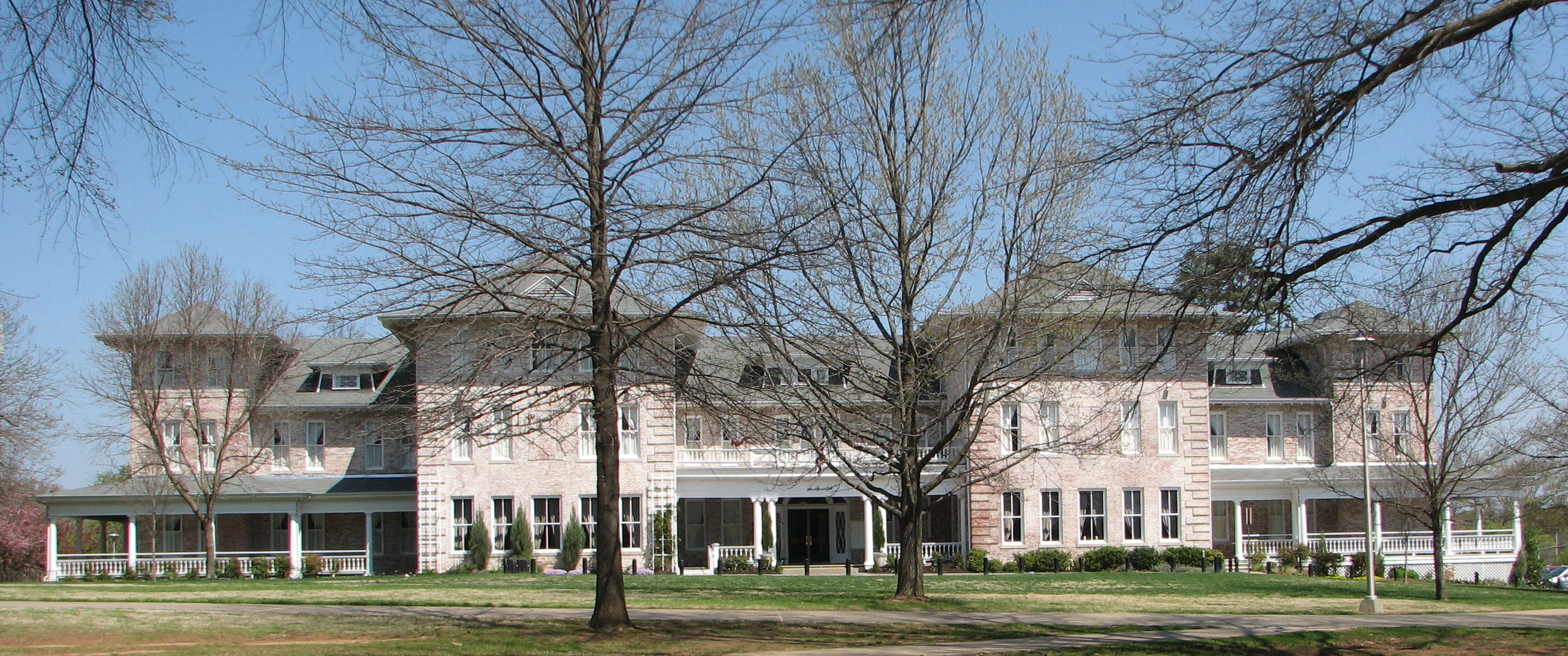
TL;DR: The Inn at Carnall Hall, at 465 North Arkansas Avenue on the University of Arkansas campus, started in 1905 as the state's first all-girls dormitory before a 2003 renovation turned it into a boutique inn (Inn at Carnall Hall; Old Buildings LLC, accessed August 2026).
Arkansas' First Dormitory for Women
Carnall Hall was built in 1905 as an all-girls dormitory -- the first of its kind in the state of Arkansas -- and named for Miss Ella Howison Carnall, a beloved English professor at the university (Inn at Carnall Hall, accessed August 2026). Discover Bella Vista, Arkansas for more on the region's historic landmarks.
A Building That Changed Purpose Several Times
The building's use shifted repeatedly over the following decades. From 1967 to 1977, it housed the Phi Gamma Delta fraternity, and by 1982 it had been repurposed for university offices and classrooms, the same year it was added to the National Register of Historic Places (Inn at Carnall Hall, accessed August 2026). In 2001, community effort and public-private partnerships stepped in to preserve the building from demolition (Inn at Carnall Hall, accessed August 2026).
A $6.3 Million Restoration
The building reopened as the Inn at Carnall Hall in 2003 following a $6.3 million renovation that restored its front porch and first-floor staircases (Inn at Carnall Hall, accessed August 2026). The following year, it joined Historic Hotels of America, a national designation reserved for properties with genuine historical significance and preservation credentials (Inn at Carnall Hall, accessed August 2026). More recently, the inn has continued to update its lobby, social spaces and on-site dining venues, Ella's Table and Lambeth Lounge (Inn at Carnall Hall, accessed August 2026).
A Landmark in the Middle of Campus
The inn sits at 465 North Arkansas Avenue, on the University of Arkansas campus itself, giving visitors -- game-day guests, visiting faculty, parents dropping off students -- a historic place to stay within walking distance of campus buildings rather than a chain hotel off a highway exit (Inn at Carnall Hall, accessed August 2026).
What More Than a Century of Reuse Says About Fayetteville
Few buildings survive four or five distinct uses -- dormitory, fraternity house, university offices, near-demolition, and finally a restored inn -- without eventually being torn down. Carnall Hall's survival reflects a specific kind of community commitment to preservation, one that showed up concretely in 2001 when it was on the verge of demolition and residents and institutions chose to save it instead. For a city that has grown as fast as Fayetteville, that willingness to preserve rather than replace older buildings is part of what still gives its historic core a distinct character.
Staying Where History Actually Happened
Boutique hotels built inside repurposed historic buildings offer something a new-construction property simply can't replicate: the sense that a space has accumulated decades of use before a guest ever checks in. A visitor staying at the Inn at Carnall Hall is sleeping inside a building that once housed the state's first female college students, then a fraternity, then university administrators -- layers of use that a brand-new hotel, however well designed, doesn't carry. That's part of why properties with genuine Historic Hotels of America credentials tend to draw a specific kind of traveler willing to pay a premium for authenticity over convenience.
Historic Preservation as an Economic Asset
Carnall Hall's survival wasn't inevitable -- in 2001 it was genuinely at risk of demolition, and only a coordinated public-private effort kept the building standing long enough to become the inn it is today. That history illustrates a broader pattern in college towns: historic buildings tied closely to a university's founding often generate enough institutional and community support to justify expensive restoration, in ways that similar buildings without that connection sometimes don't survive to see. For a city weighing how to handle its own aging landmarks, Carnall Hall stands as a working example that adaptive reuse -- turning a historic structure into a functioning, revenue-generating business -- can be a more durable preservation strategy than treating a building as a static museum piece with no ongoing use. A building that pays for its own upkeep tends to outlast one that depends entirely on grants and donations, which is a large part of why Carnall Hall is still standing while comparable buildings elsewhere were lost decades ago.
Working With Mason Capital Group in Fayetteville
Mason Capital Group has 30+ years of experience in Northwest Arkansas and $2.4B+ in cumulative transaction activity. We operate from 609 SW 8th Street, 6th Floor, Bentonville, AR 72712, and can be reached at 479-925-3333.
If you're looking for the best real estate agent in Fayetteville, Arkansas, or want to talk through what living near the University of Arkansas campus is like, we're happy to help. Current inventory is on our featured listings page, and if you're selling nearby, list your home with us.
Where is the Inn at Carnall Hall located?
465 North Arkansas Avenue, on the University of Arkansas campus in Fayetteville (Inn at Carnall Hall, accessed August 2026).
What was Carnall Hall originally built for?
It was built in 1905 as Arkansas's first all-girls dormitory (Inn at Carnall Hall, accessed August 2026).
When did it become a hotel?
The building reopened as the Inn at Carnall Hall in 2003 after a $6.3 million renovation (Inn at Carnall Hall, accessed August 2026).
Is the building historically registered?
Yes -- it was added to the National Register of Historic Places in 1982 (Inn at Carnall Hall, accessed August 2026).